
1. Where this actually stands right now
Strip away the press-release language and the timeline is simple:
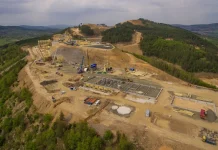
- December 9–26, 2025: early public insight (“rani javni uvid”) period for the Spatial Plan of the Special Purpose Area for the Čoka Rakita ore deposit, in the Crni Vrh area the planning document that legally carves out the land for the mine. It closed on December 26, 2025. This is the document the Bird Protection and Study Society of Serbia (DZPPS/BirdLife Serbia) formally objected to, and the objection is what this summary is built on.
- January 2026: DPM filed its Feasibility Study for Čoka Rakita.
- Mid-2026: Ada Tepe, DPM’s mine in Krumovgrad, Bulgaria, ceased ore processing (July 15, 2026). Its processing plant is being dismantled and shipped to Serbia for reuse at Čoka Rakita the company’s own stated plan to cut capital cost and shorten the build.
- End 2026 : DPM is
- Early 2027: construction of Čoka Rakita is DPM’s current target start.
- 2028 and beyond: first production.
That means the spatial-plan objection filed in December 2025 wasn’t a formality it was the one moment in this entire process where the public comment is supposed to shape the plan before the land is legally allocated to the mine. That window has already closed once. What happens next adoption of the plan, environmental permitting, construction permits, mining and exploitation licenses moves faster and gives the public less room to change the outcome at each successive stage.
2. What the mine will actually do to the ore (as described by the DPM company)
No cyanide is used in this design that much is a genuine change from the original 2021 open-pit/cyanide concept, forced by earlier local resistance. The process, per DPM’s own description:
- Run-of-mine ore passes over a vibrating grizzly feeder; oversize goes to a primary jaw crusher.
- Crushed and undersize material feeds a single-stage semi-autogenous grinding (SAG) mill with a cyclone cluster.
- Part of the cyclone underflow goes to two parallel gravity concentration circuits, separating heavy gold particles from lighter waste rock. This gravity concentrate is dewatered and bagged directly.
- The remaining gravity tailings go to a flotation circuit (three Jameson cells) to recover sulphide-rich material.
- Flotation concentrate is thickened, filtered, dewatered, and stockpiled for truck transport.
- Flotation tailings are thickened and either sent to a tailings storage facility (TSF) or used in a paste backfill plant underground.
The absence of cyanide does not mean the absence of risk. A tailings storage facility is a permanent engineered structure holding fine-ground waste rock and process water, typically for the life of the mine and long after the same general class of infrastructure whose failures have caused the region’s worst-known mining disasters (Baia Mare’s cyanide spill, but also non-cyanide tailings dam failures elsewhere). “No cyanide” changes which chemical is present. It does not change the fact that a permanent waste-storage structure will sit above a hydrologically active karst massif.
3. What DZPPS/BirdLife’s formal objection documents
This is the substantive part. Their December 26, 2025 filing to Serbia’s Spatial Planning Agency raises seven distinct problems, and asks that the draft spatial plan be rejected in its entirety:
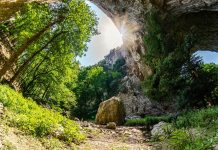
a) Karst hydrogeology the central danger. The Homolje and Crni Vrh massif sits on porous karst terrain riddled with sinking rivers (ponornice) and springs, feeding a multiply-connected system of deep groundwater and reservoirs. This terrain is fundamentally unsuited to industrial contamination risk. The site sits in the catchment of the Pek and Mlava river springs. If the closed-loop water and tailings system fails during operation or after closure the objection states this risks permanent, irreversible contamination, with the Mlava spring potentially drying up entirely if compounded by deforestation and existing hydrological stress (the river is already degraded by a small hydropower plant and the Ribareva gorge works, and drought has already weakened the Žagubica spring).
b) No hydrogeological study was done before planning began. On karst terrain with multiple springs and sinkholes, a hydrogeological study establishing whether a mine here is safe at all should have preceded the plan, not followed it. Its absence is flagged as a breach of Serbia’s Law on Environmental Impact Assessment (Off. Gazette RS 94/2024, Arts. 11, 12, 17).
c) No Strategic Environmental Assessment (SEA) was published or opened to consultation, despite being legally required to run in parallel with the plan’s drafting and be available during the exact phase when public input can still shape it. The objection cites this as a breach of Serbia’s Law on Strategic Environmental Assessment, Art. 3(2) and (3).
d) Proximity to internationally significant bird habitat. The proposed mine site sits roughly 1 km from three Important Bird Areas that are also forming into Natura 2000 sites: Homolje, Kučaj–Beljanica, and Veliki Krš i Stol. DZPPS’s own 2022–2025 field surveys recorded 81 bird species (79 breeding) at the site 31 listed on Annex I of the EU Birds Directive, 74 protected under the Bern Convention, 67 strictly protected under Serbian law, 6 in Serbia’s Red Book. Notable breeding species include the white-backed woodpecker, middle spotted woodpecker, grey-headed woodpecker, a pair of golden eagles, the Ural owl, and the collared flycatcher.
e) No biodiversity assessment to IFC Performance Standard 6 (the international standard for biodiversity conservation and sustainable natural-resource management) has been produced meaning the project’s risk to ecosystem services and biodiversity hasn’t been formally identified, despite direct and indirect impacts (habitat loss and fragmentation, altered surface hydrology, invasive species, land-use conversion) being exactly what PS6 exists to catch.
f) No opportunity-cost / net-present-value analysis comparing the short-term revenue of an ~8-year mining and processing period against the long-term value of 30-plus years of sustainable development ecotourism, a national park designation, organic agriculture, and the area’s already-branded Homolje honey. Once the terrain is industrially degraded, the objection notes, reversing that damage or credibly arguing against further expansion becomes very difficult.
g) Procedural exclusion undermining the mine’s social license to operate. The nearest settlements Laznica and Žagubica are formally excluded from the plan’s boundary, which blocks their full participation and directly undercuts the “Social Licence to Operate” the project would need. Serbia is a signatory to the Aarhus Convention, which guarantees the public’s right to timely, complete, and effective participation in environmental decisions; the objection states this was violated (Arts. 6(3), 6(4), 6(6), and 7), because the underlying SEA documentation was never made available for the public to actually respond to.
h) A direct legal-protection conflict. Serbia’s Law on Nature Protection (Art. 74) prohibits the use, destruction, or endangerment of strictly protected wild species, their habitats, or fungi. DZPPS states that the permanent destruction and degradation of the surface and underground habitats involved, plus regional groundwater contamination risk, would constitute an unambiguous breach of this article. Also flagged: caves in the planned mine footprint already host significant colonies of more than 25 bat species, used as hibernation sites species already under pressure from the nearby Crni Vrh wind farm, and now facing the further threat of the caves themselves being destroyed.
4. The pattern worth naming
None of this is abstract activism it’s a specific, technical, citable list of legal and procedural gaps in the process as currently run: no hydrogeological study, no SEA, no IFC PS6 assessment, no opportunity-cost analysis, excluded nearest villages, and a formal Aarhus Convention breach. That’s not an emotional case against mining in general.
It’s a case that this specific plan, on this specific karst terrain, has skipped the steps that would tell anyone regulator, company, or resident whether it’s actually safe. That gap is the leverage point: it’s exactly what a legal challenge, an EU-accession complaint, or a court appeal would be built on.